 Image 1 of 2
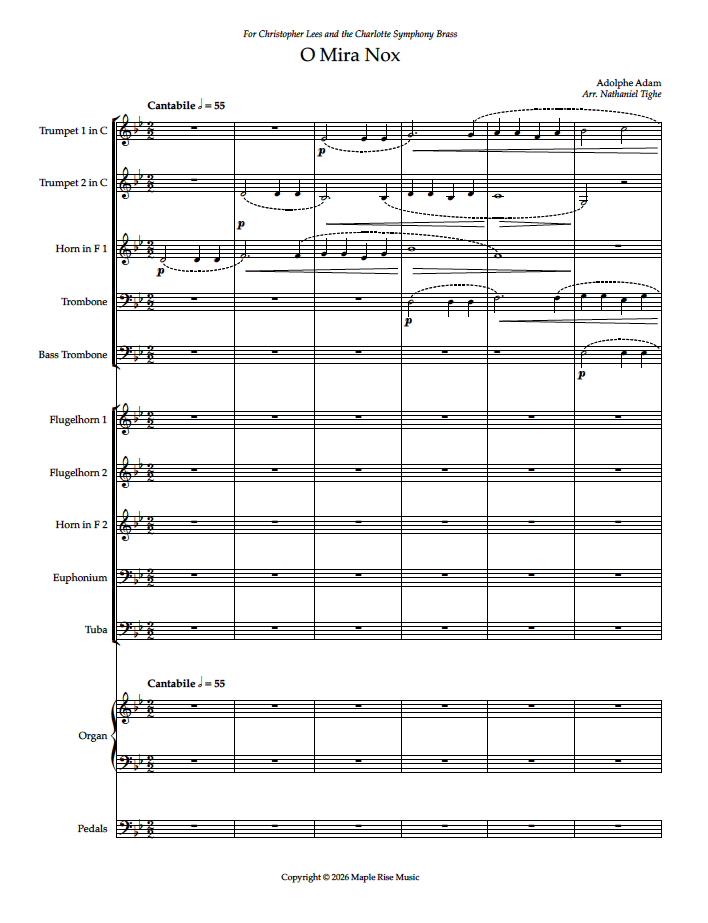 Image 2 of 2
O Mira Nox
Based on “Cantique de Noël” by Adolphe Adam
Arranged by Nathaniel Tighe
For Double Brass Quintet and Organ
Duration: 3 minutes
PDF Download only, score and parts
This piece reimagines “Cantique de Noël,” known in English as “O Holy Night,” the beloved carol with music by Adolphe Adam set to a poem by Placide Cappeau. Written in 1847, it remains one of the most popular Christmas carols ever composed, and it is said to be the first piece of music ever broadcast by radio, on Christmas Eve 1906.
While the carol’s poignant evocation of the Nativity has echoed forward through history, this arrangement imagines what might have been if the music could also ripple backward in time. The opening section envisions the melody in the hands of Renaissance polyphonists such as Palestrina, the Gabrielis, and Thomas Tallis. At the midpoint, the perspective shifts forward to the early twentieth century, conjuring how a composer like Ralph Vaughan Williams, ever drawn to the sacred music of Tudor England, might have treated the music if he had encountered the carol in the form heard at the beginning. From there, the piece makes its gradual way to the present day, where modern harmonies bring it to a triumphant close.
Written for Christopher Lees and the Charlotte Symphony Brass


